ABSTRACT
The effectiveness of cancer treatment depends significantly on the role of early diagnosis of the disease. In this regard, the use of artificial intelligence-based screening
methods plays an important role in increasing the likelihood of patient recovery, as well as effectively ensuring cost-effectiveness. Currently, much attention is paid to
artificial intelligence-based machine learning methods in the field of biomedicine, which is of great importance in advancing our understanding of complex biological
processes. In our previous studies, we considered the classification of human blood plasma based on Fourier transform infrared (FTIR) spectra using artificial intelligence,
and succeeded in identifying healthy individuals and lung cancer patients with an accuracy of 80-90%, respectively. The advantages of the method used are its low cost,
speed and minimal invasiveness. The fact that the protein component in whole blood plasma is significantly less than the lipid component leads to a decrease in the role of
the lipid component in the classification. However, a significant change in the cellular lipid composition in cancer patients can be explained by the manifestation of this
phenomenon in plasma lipids. In this regard, based on the low content of lipid components in plasma, the present study considered the application of the screening method to
lipid fractions to provide additional value. The approach based on lipid fractions extracted from plasma using statistical methods such as Linear-SVM, PLS-DA, Random Forest
allowed the classification of healthy and lung cancer patients by 80-78%, respectively. The obtained result may be an important criterion for conducting large-scale clinical
trials of screening methods.
Keywords: Artificial intelligence, Metaboanalyst, FTIR, lung carcinoma, plasma lipid
DOI:10.70784/azip.2.2025256
Received: 29.05.2025
Internet publishing: 17.06.2025 AJP Fizika A 2025 02 az p.56-61
AUTHORS & AFFILIATIONS
1. Institute of Biophysics, Ministry of Science and Education Republic of Azerbaijan 117 Z. Khalilov, Baku, AZ 1141
2. National Oncology Center of the Ministry of Health of the Republic of Azerbaijan, 79B H. Zardabi str.
E-mail: oktaygasimov@gmail.com
Graphics and Images
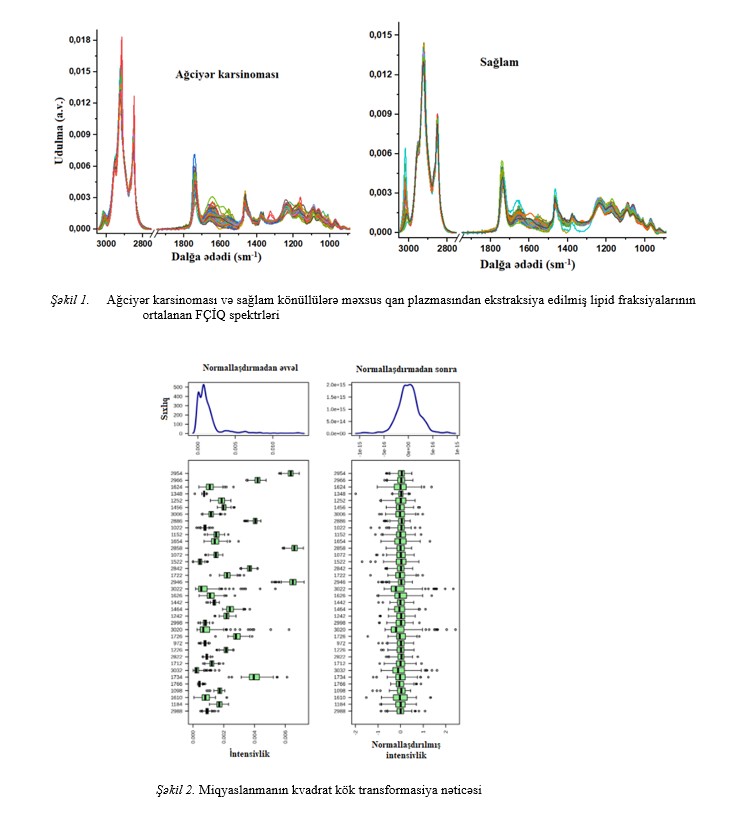
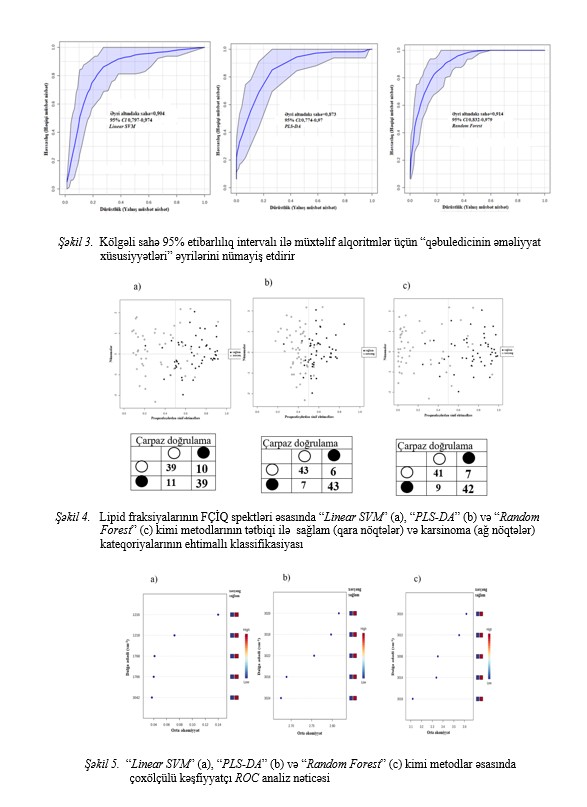
Fig.1-2 Fig.3-4-5
|
[1] O.R. Parpieva, A.D. Ostanqulov. Modern Scientific Research in Oncological Diseases; The American Journal of Medical Sciences and Pharmaceutical Research. 2021, V.3, Issue 03-17, p.117-121
[2] J.D. Minna, J.A. Roth, A.F.Gazdar. Focus on lung cancer; Cancer Cell. 2002, V.1, Issue 1, p. 49-52.
[3] S.Doppalapudi, R.G.Qiu, Y.Badr. Lung cancer survival period prediction and understanding-Deep learning approaches; International Journal of Medical Informatics. 2021, V.148, p.1-12.
[4] O.K. Gasymov, A.H. Aydemirova. Artificial Intelligence to classify human lung carcinoma using blood plasma FTIR spectra; Applied Computational Math. 2021, V.20, Issue 2, p.277-289.
[5] O.G. Chechekina, E.V. Tropina. Machine learning assisted rapid approach for quan-ve prediction of biochemical parameters of blood serum with FTIR spectroscopy; Spectrochemica Acta Part A-Molecular and Biomolecular Spectroscopy; 2025, V.326.
[6] A.H. Aydəmirova, L.Ə. Məlikova. FÇİQ tətbiqi ilə insanın sağlam və ağciyər karsinoması halında plazma-lipid modelinin diaqnostik mümkünlüyü; AJP Fizika, № XXIX, I, s.3-9.
[7] N. Galant, M. Nicos; Application of FTIR spectroscopy in liquid biopsy to predict the responce to the first-line immunotherapy; Biochemical and Biophysical Research Communication; 2025, V.771, p.1-29.
|