ABSTRACT
In this study, the dependence of the electrical conductivity of semiconductor nanotubes (SNTs) on key parameters-temperature, doping level, and diameter-was modeled and
predicted using an artificial neural network (ANN) approach. A semi-empirical model was used to generate 2,000 synthetic data samples, and based on these, an ANN was
implemented in the TensorFlow/Keras framework. The results indicate that as temperature increases, enhanced phonon scattering leads to a decrease in conductivity, whereas
increases in doping concentration and nanotube diameter result in higher conductivity due to an increased number of charge carriers and reduced surface scattering.
Keywords: semiconductor, nanotube, neural network, machine learning
DOI:10.70784/azip.1.2025257
Received: 17.06.2025
Internet publishing: 20.06.2025 AJP Fizika E 2025 02 en p.57-59
AUTHORS & AFFILIATIONS
1. Institute of Physics Ministry of Science and Education of Azerbaijan, H. Cavid Avenue 131, 1073
2. Azerbaijan Technical University, Baku, H. Javid ave., 25
E-mail:
Graphics and Images
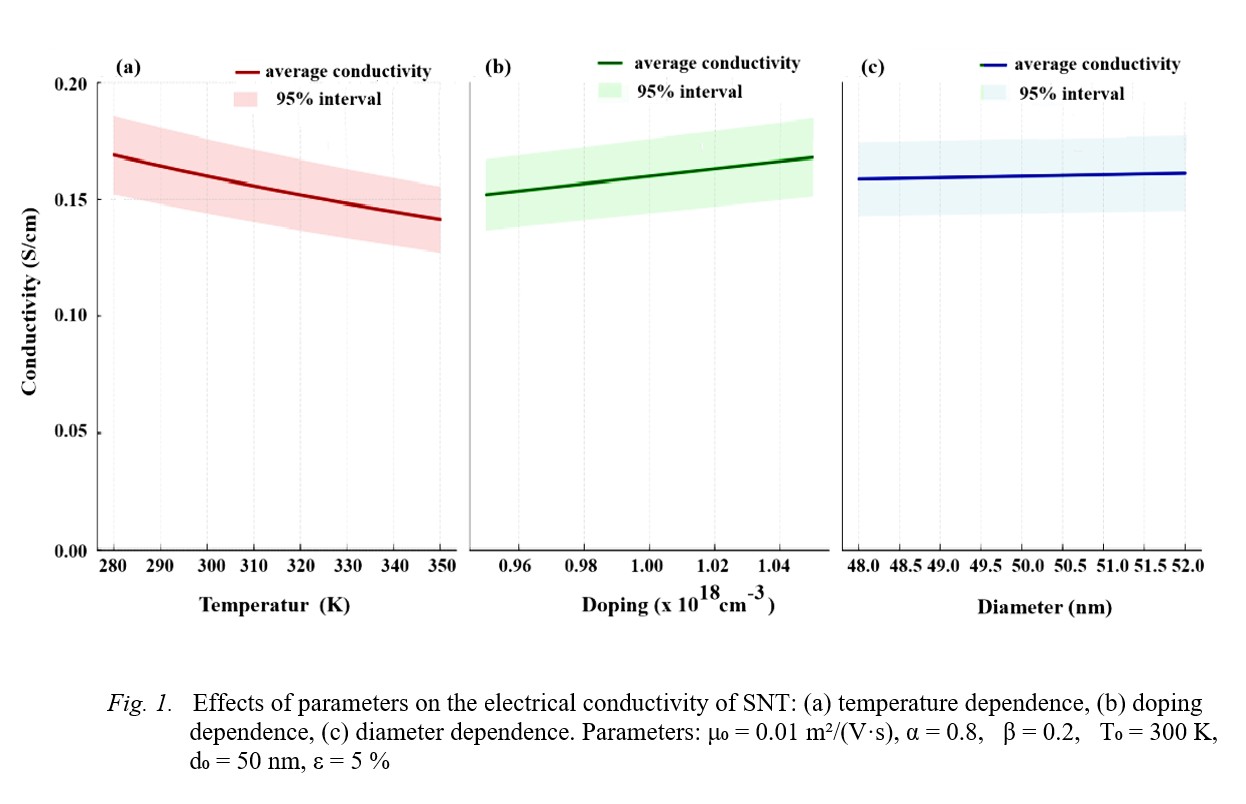
Fig.1
|
[1] Z.L. Wang. 2004. Zinc Oxide Nanostructures: Growth, Properties and Applications. Journal of Physics: Condensed Matter, 16(25), R829–R858. DOI: 10.1088/0953-8984/16/25/R01
[2] J. Smith, et al. 2019. Electrical conductivity of doped carbon nanotubes: Experimental and theoretical study. Physical Review B, 99(15), 155432. DOI: 10.1103/PhysRevB.99.155432
[3] Y. Zhang, et al. 2022. Machine learning approaches for nanomaterials characterization. Nature Nanotechnology, 17(3), 245–258. DOI: 10.1038/s41565-021-01030-2
[4] H. Kim, et al. (2020). Application of neural networks to predict electrical conductivity of nanostructures. Nano Letters, 20(4), 2212–2218. DOI: 10.1021/acs.nanolett.9b05147
[5] X. Liu, Y. Zhang, Z. Wang. 2023. Machine learning-assisted prediction of electrical conductivity in semiconductor nanowires. Nano Energy, 98, 107325. https://doi.org/10.1016/j.nanoen.2022.107325
[6] L. Wang, X. Li. 2020. Predictive modeling of semiconductor nanotubes using deep learning. Journal of Applied Physics, 128(10), 104301. DOI: 10.1063/5.0021234
[7] C. Zhang, S. Bengio, M. Hardt, B. Recht, O. Vinyals. 2021. Understanding Deep Learning Requires Rethinking Generalization. Communications of the ACM, 64(3), 107–115. DOI: 10.1145/3446776
[8] M. Raghu, B. Poole, J. Kleinberg, S. Ganguli, & J. Sohl-Dickstein. 2017. On the Expressive Power of Deep Neural Networks. International Conference on Machine Learning (ICML), 70, 2847–2854.DOI: 10.5555/3305381.3305518
[9] J. Smith, L. Zhao. 2022. Data-driven modeling of semiconductor properties using deep neural networks. Computational Materials Science, 205, 110450. DOI: 10.1016/j.commatsci.2022.110450
[10] C. Unsalan, B. Hoke, E. Atmaca. 2024. Embedded Machine Learning with Microcontrollers. Springer. https://doi.org/10.1007/978-3-031-70912-8
[11] Z. Zhang. 2024. Research on mechanical parts precision evaluation based on machine learning. In SPIE Conference on Intelligent Mechanical and Human–Machine Systems. DOI: 10.1117/12.3050333
[12] D. Mane, P. Barapate, & P. Khinde. 2024. Early Lung Cancer Detection Using CNN. 2023 4th International Conference on Communication and Signal Processing (ICCSP), IEEE. p.1-6 DOI: 10.1109/ICCSP58952.2024.10627340
[13] X. Li, L. Shi. 2024. Open problems in transport physics of ultrahigh-thermal conductivity materials. Journal of Materials Research. DOI: 10.1557/s43578-024-01441-2
[14] Y. Xu, H. Li. 2021. Prediction of nanomaterial conductivity using artificial neural networks. Materials Today Communications, 27, 102226. DOI: 10.1016/j.mtcomm.2021.102226
[15] Z. Zhang, et al. 202). ML-based modeling for nano-device electronic properties. Journal of Applied Physics, 134(3), 034501. DOI: 10.1063/5.0133456
|