ABSTRACT
This work proposes a model of the LDS particle (Localized Dynamical Structure) as a stable form of density existing within the geometry of closed space. The LDS particle is
treated not as a point-like object but as a topologically conditioned localization arising from the coupling of medium and excitation curvatures. The trajectory is
understood as a tunnel of metric coupling rather than motion along a coordinate grid. The model explains the origin of mass as an effective measure of the medium’s
resistance to density and phase restructuring and derives antisymmetry and spin as consequences of topological constraints. Experimental data from the Voyager 1/2 missions
are interpreted in terms of an extended curvature-coupling region (the heliopause), where diffuse magnetic structures and ion distributions (H⁺, He²⁺) are observed. These
results are considered as evidence of the universality of the LDS model, applicable at both microscopic and cosmic scales. The model is further extended by incorporating the
concept of a nanoscale layer and its dynamic evolution, allowing a rethinking of trajectory metric coupling as a self-organizing region where geometry, density, and spin
states are bound through a dynamic nanoscale interface. This layer acts as an adaptive boundary between the medium and the inhomogeneity, enabling stable trajectories even
under varying metrics. Such an approach allows the analysis of systems where surface effects and local anisotropy are critical, such as thin ferrite films and hybrid
spin–photon structures. In this paradigm, mass and motion lose their primary status, giving way to the concepts of stable connectivity and effective medium resistance.
Keywords: Voyager 1/2, topology of environment, tunnel effect, magnetic field
DOI:10.70784/azip.1.2025340
Received: 03.09.2025
Internet publishing: 19.09.2025 AJP Fizika E 2025 03 en p.40-49
AUTHORS & AFFILIATIONS
1. Institute of Physics named after H.M. Abdullayev, Ministry of Science and Education of the Republic of Azerbaijan, 131 H. Javid Ave., Baku, AZ-1073, Azerbaijan
2. Azerbaijan State Oil and Industry University(ASOIU), Az-1010, Baku, Azerbaijan
E-mail: jophphysics@gmail.com
Graphics and Images
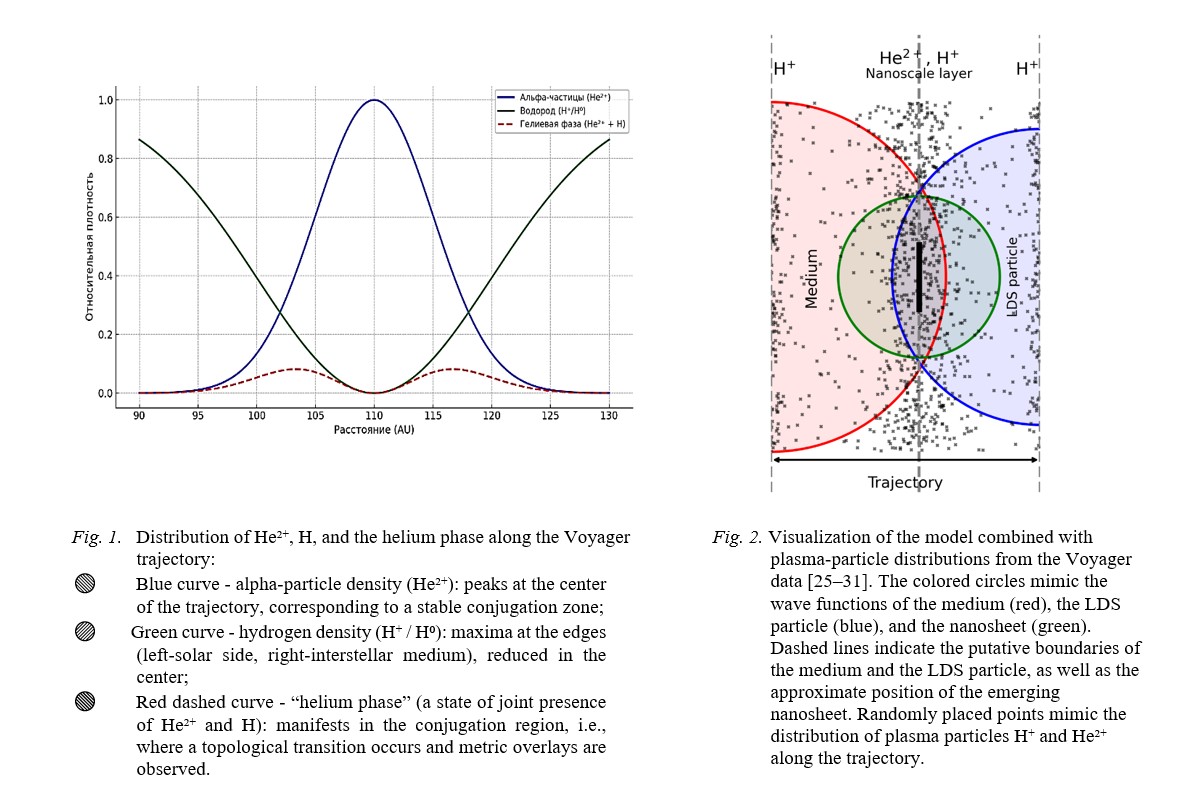
Fig.1-2
|
[1] P. A. M. Dirac. The Principles of Quantum Mechanics. Oxford, 1930.
[2] L.D. Landau, E.M. Lifshitz. The Classical Theory of Fields. Pergamon, 1971.
[3] N.W. Ashcroft, N.D. Mermin. Solid State Physics. Saunders College, 1976.
[4] R. Penrose. Cycles of Time: An Extraordinary New View of the Universe. Bodley Head, 2010.
[5] R.B. Laughlin. Different Universe: Reinventing Physics from the Bottom Down. Basic Books, 2005.
[6] NASA MAG Voyager site: https://voyager.gsfc.nasa.gov/
[7] Mikio Nakahara. Geometry, Topology and Physics, Kinki University, Osaka, Japan, 2003, Institute of Physics Publishing, Bristol and Philadelphia
[8] A.C. Scott. Nonlinear Science: Emergence and Dynamics of Coherent Structures. Oxford, 2003, https://doi.org/10.1093/oso/9780198528524.001.0001
[9] N. Manton, P. Sutcliffe. Topological Solitons. Cambridge University Press, 2004.
[10] G.E. Volovik. The Universe in a Helium Droplet. Oxford University Press, 2003.
[11] T. Dauxois, M. Peyrard. Physics of Solitons. Cambridge University Press, 2006.
[12] T.R. Mehdiyev, A.M. Hashimov, Sh.N. Aliyeva. Generalized Hamiltonian of the resonant metric of the active state of the medium. AJP FIZIKA, 2025, Vol.XXXI, № 2, Section:E, pp.60–73. DOI: 10.70784/azip.1.2025260
[13] M.C. Gutzwiller. Chaos in Classical and Quantum Mechanics. Springer, 1990, https://doi.org/10.1002/zamm.19920721221
[14] M. Nielsen, I. Chuang. Quantum Computation and Quantum Information. Cambridge, 2000, www.cambridge.org Information on this title: www.cambridge.org/978110700217
[15] Haldane F. D. M. Nobel. Lecture: Topological Quantum Matter. Rev. Mod. Phys. 89, 040502 (2017), DOI: https://doi.org/10.1103/RevModPhys.89.040502
[16] M.V. Berry. Quantal Phase Factors Accompanying Adiabatic Changes. Proc. R. Soc. Lond. A, 392, 45–57, 1984. https://doi.org/10.1098/rspa.1984.0023
[17] D.A. Gurnett, W.S. Kurth, L.F. Burlaga, N.F. Ness. In Situ Observations of Interstellar Plasma with Voyager 1. Science, 341, 1489, 2013, DOI: 10.1126/science.1241681
[18] L.F. Burlaga, N.F. Ness, M.H. Acuña, R.P. Lepping, J.E. Connerney, J.D. Richardson. Magnetic fields at the solar wind termination shock. Nature 454, 75–77, 2008.
[19] L.F. Burlaga, N.F. Ness, M.H. Acuña, R.P. Lepping, J.E. Connerney, E.C. Stone, F.B. McDonald. Crossing the termination shock into the heliosheath: Magnetic fields. Science 309, 2027–2029, 2005.
[20] L.F. Burlaga, N.F. Ness, M.H. Acuña. Crossing the Termination Shock into the Heliosheath: Magnetic Fields. Science, 309, 2027, 2005. PMID: 16179471, DOI: 10.1126/science.1117542
[21] E.C. Stone, A.C. Cummings, F.B. McDonald. Voyager 1 Observes Low-Energy Galactic Cosmic Rays. Science, 341, 150, 2013, DOI: 10.1126/science.1236408.
[22] M. Opher, J.F. Drake, B. Zieger, T.I. Gombosi. Magnetized Jets Driven by the Sun: The Structure of the Heliosphere. Astrophys. J. Lett. 800, L28, 2015. DOI:10.1088/2041-8205/800/2/L28 ; 10.48550/arXiv.1412.7687
[23] N.S. Svirzhevsky, G. Bazilevskaya, M.S. Kalinin, M.B. Krainev. V.S. Makhmutov, A.K. Svirzhevskaya, Y.I. Stozhkov. Heliospheric Magnetic Field and The Parker Model/ Geomagnetism and Aeronomy, May 2021, 61(3):299-311, DOI: 10.1134/S0016793221030154
[24] N.V. Pogorelov, J. Heerikhuisen, V. Roytershteyn, L.F. Burlaga, D.A. Gurnett and W.S. Kurth. Three-dimensional features of the outer heliosphere due to coupling between the interstellar and heliospheric magnetic field. Astrophys. J. 845, 9, 2017, DOI 10.3847/1538-4357/aa7d4f
[25] E.C. Stone, A.C. Cummings, F.B. McDonald, B.C. Heikkila, N. Lal, W.R. Webber. Voyager 1 Observes Low-Energy Galactic Cosmic Rays in a Region Depleted of Heliospheric Ions. Science, Vol. 341, Issue 6142, pp. 150–153, 2013, DOI:10.1126/science.1236408
[26] S.M. Krimigis, D.G. Mitchell, E.C. Roelof, K.C. Hsieh, D.J. McComas. Search for the Exit: Voyager 1 at Heliosphere’s Border with the Galaxy Science, Vol. 341, Issue 6142, pp. 144–147, 2013, DOI: 10.1126/science.124071
[27] NASA Planetary Data System (PDS) — данные эксперимента Plasma Science Experiment (PLS) / Plasma Wave Subsystem (PWS) по распределению плазменных частиц «Вояджера». https://pds.nasa.gov/ds-view/pds/viewCollection.jsp?identifier=urn%3Anasa%3Apds%3Avg1-pls-jup%3Adata-ion-inbndwind-96s
[28] Voyager 1 PLS — Jupiter Data Bundle (Plasma Science Experiment); Richardson, J.D., Voyager 1 Plasma Science Experiment (PLS) Jupiter Data Bundle, 2021, DOI: 10.17189/1522981; Архив данных PLS, собран¬ных во время пролёта у Юпитера; включает ранее выпущенные наборы (PDS3) о моментах электронов, ионов, L и M режимах, с разрешением 96с. pds.nasa.gov+15pds.nasa.gov+15pds.nasa.gov+15; https://pds.nasa.gov/ds-view/pds/viewBundle.jsp?identifier=urn%3Anasa%3Apds%3Avg1-pls-jup&version=1.0
[29] Voyager 1 PLS — 1-Hour Averaged Proton Moments (Solar Wind); Richardson, J.D. Voyager1 PLS Solar System 1 Hour Averaged Proton Moments Data Collection, 2021, DOI: 10.17189/1522967. Часовые усреднённые моменты протонов в RTN-координатах, охваты-вающие период с 1977 по 1980 год. pds-ppi.igpp.ucla.edu+15pds.nasa.gov+15pds.nasa.gov+15; https://pds.nasa.gov/ds-view/pds/viewCollection.jsp?identifier=urn%3Anasa%3Apds%3Avg1-pls-ss%3Adata-hour::1.0
[30] Voyager 1 PLS — Solar Wind Fine Resolution Data; Voyager1 plasma data of the solar wind, fine resolution data (VG1 SS PLS 3 RDR FINE RES V1.0), DOI: 10.17189/1519930. Детальный (fine resolution) набор данных по солнечному ветру, измеренный PLS. pds-ppi.igpp.ucla.edu+15pds.nasa.gov+15pds.nasa.gov+15pds.nasa.gov; https://pds.nasa.gov/ds-view/pds/viewDataset.jsp?dsid=VG1-SS-PLS-3-RDR-FINE-RES-V1.0
[31] Voyager 1 PWS — Raw Waveform Data (Electric Waveforms); W.S. Kurth, C.W. Piker, L.J. Granroth, J.B. Faden. Voyager1 PWS Electric Waveforms Data Collection, 2022, DOI: 10.17189/g5fy-rz59. Сырая, высокоразрешённая коллекция волн — электрические поля — за всю миссию. pds-ppi.igpp.ucla.edu+15pds.nasa.gov+15pds.nasa.gov+15;https://pds.nasa.gov/ds-view/pds/viewCollection.jsp
|