ABSTRACT
This study investigates the temperature dependence of the dielectric properties of polypropylene (PP) + nanoclay (NC) nanocomposites. The results show that the dielectric
permittivity (ε') of PP + NC nanocomposites increases with rising temperature. For example, the ε' of the PP + 10% NC composite increased by 40%. However, after reaching
393K, ε' starts to decrease. At the same time, the dielectric loss tangent (tgδ) increases with temperature, significantly rising at higher temperatures. These findings
demonstrate that the dielectric characteristics of PP + NC nanocomposites change with temperature, making these materials potentially useful for insulation applications
under various temperature conditions.
Keywords: dielectric permittivity, dielectric loss, nanocomposites, nanoclay, polypropylene
DOI:10.70784/azip.2.2025418
Received: 24.11.2025
Internet publishing: 25.11.2025 AJP Fizika A 2025 04 az p.18-21
AUTHORS & AFFILIATIONS
1. Azerbaijan State Oil and Industry University, 20 Azadlig ave. Baku, AZ 1010, Azerbaijan
2. Azerbaijan-French University under the Azerbaijan State Oil and Industry University (UFAZ), 183 Nizami St., Baku, Az1000
E-mail: aynura.hadiyeva@asoiu.edu.az
Graphics and Images
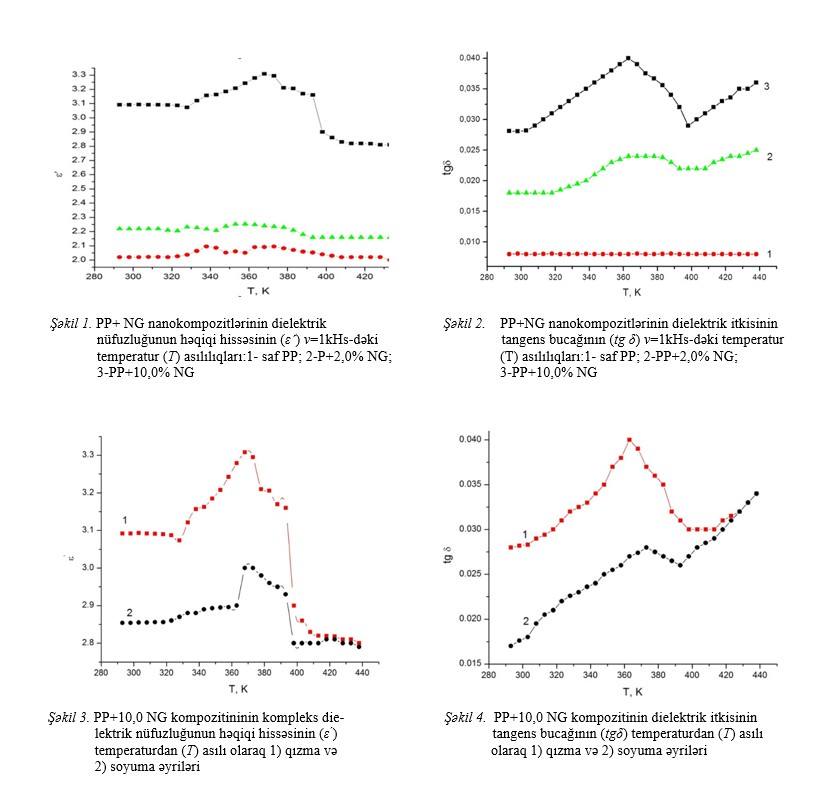
Fig.1-2-3-4
|
[1] A.R. Sadiqova, P.B. Əsilbəyli, A.Ə. Hadiyeva, X.O. Sadiq, İ.M. İsmayilov, V.Ə. Ələkbərov. Polipropilenin elektrofiziki xassələrinə nanogilin təsiri, AJP Fizika, 2023, section C: Conference H.A. Aliyev, p. 63-66.
[2] M.A. Musayev, A.Ə. Hadiyeva, A.N. Cəfərova. Müxtəlif temperaturlarda və polyarlaşma gərginliklərində polipropilen əsasli nanogil əlavə edilmiş kompozitlərin elektret xassələri, AJP Fizika, v.XXIX, № 4, s.7-11.
[3] A.R. Sadiqova, A.Ə. Hadiyeva, P.B. Əsilbəyli. Elektrik sahəsinin təsiri ilə polietilen+nanogil nanokompozitlərində baş verən molekulyar proseslər. AJP Fizika, 2021, v.XXVII, № 3, s.17-22.
[4] M. Кuliev, O. Samedov, R. Ismayilova. The temperature- frequency dispersion of the dielectric characteristics of composite materials based on polyethylene with TlInS2 inclusions, Surface Engineering and Applied Electrochemistry, 2012, v. 40, № 2, p. 91-96.
[5] M. Ramazanov, S. Abasov, Z. Mustafaev et al. Dielectric and strength properties of the polymer compositions. Surface engineering and applied electrochemistry, 2006, № 5, p. 61.
[6] A. Hadiyeva, M. Ramazanov. The influence of nanoclay to the electrophysics properties of polypropylene/1st International scientific conference of young scientists and specialties, Baku: 2014, p. 199-201.
[7] P. Shepherd, F. Golemba, F. Maine. Clay layers, Adv. Chem.Ser., 1974, v.41, № 6, p. 134.
[8] А.Б. Турик, М.Ю. Родинин. Диэлектрические потери в материалах с ограниченной областью распределения времени релаксации. Письма в ЖТФ, 2010, т. 36, № 1, с. 37-43.
[9] M.M. Кулиев, P.C. Исмайилова. Диэлектрические и электрические свойства композитов с пьезоэлектрическим наполнителем. Пластические массы, 2012, № 4, с. 10-13.
[10] Д.Н. Войлов и др. Диэлектрические свойства нанокомпозитов на основе полиамида 6 и металлосодержащих соединений. Пластические массы, 2008, № 3, с. 15-18.
[11] A.E. Hadieva, A.R. Sadigova, V.A. Alekperov, H.S. İbragimova. Dielectric properties of PP and PP+Dk1 nanocomposites in different percentage,
AJP Physics, № 4, v.22, 2016, p.7-9.
|