ABSTRACT
Carbon nanotube (CNT)-reinforced epoxy nanocomposites have attracted significant interest due to their potential in advanced structural and functional applications. In this
study, thin-film nanocomposites containing 2 wt% multi-walled carbon nanotubes (MWCNTs) were prepared using a bisphenol-A–based epoxy resin (EDP) and a polyamine hardener.
The morphology and chemical structure of the nanocomposites were investigated using Atomic Force Microscopy (AFM) and Fourier-transform infrared spectroscopy (FTIR). AFM
images revealed a non-uniform dispersion of CNTs, where both nanoscale networks and agglomerated regions were observed. FTIR spectra indicated partial epoxy ring opening
and confirmed the persistence of key functional groups in the cured matrix. The combined results demonstrate that CNT dispersion quality and matrix–filler interactions play
a decisive role in defining the structural features of CNT/epoxy nanocomposites. These findings highlight the importance of optimizing preparation and mixing parameters to
improve composite uniformity and functional performance.
Keywords: AFM, FTIR, carbon nanotube, epoxy nanocomposite, morphology
DOI:10.70784/azip.1.2025442
Received: 18.12.2025
Internet publishing: 24.12.2025 AJP Fizika E 2025 04 en p.42-45
AUTHORS & AFFILIATIONS
French-Azerbaijani University (UFAZ), Azerbaijan State Oil and Industry University, Baku, Azerbaijan
Institute of Physics, Ministry of Science and Education, Baku, Azerbaijan
E-mail: taranaoruc@gmail.com
Graphics and Images
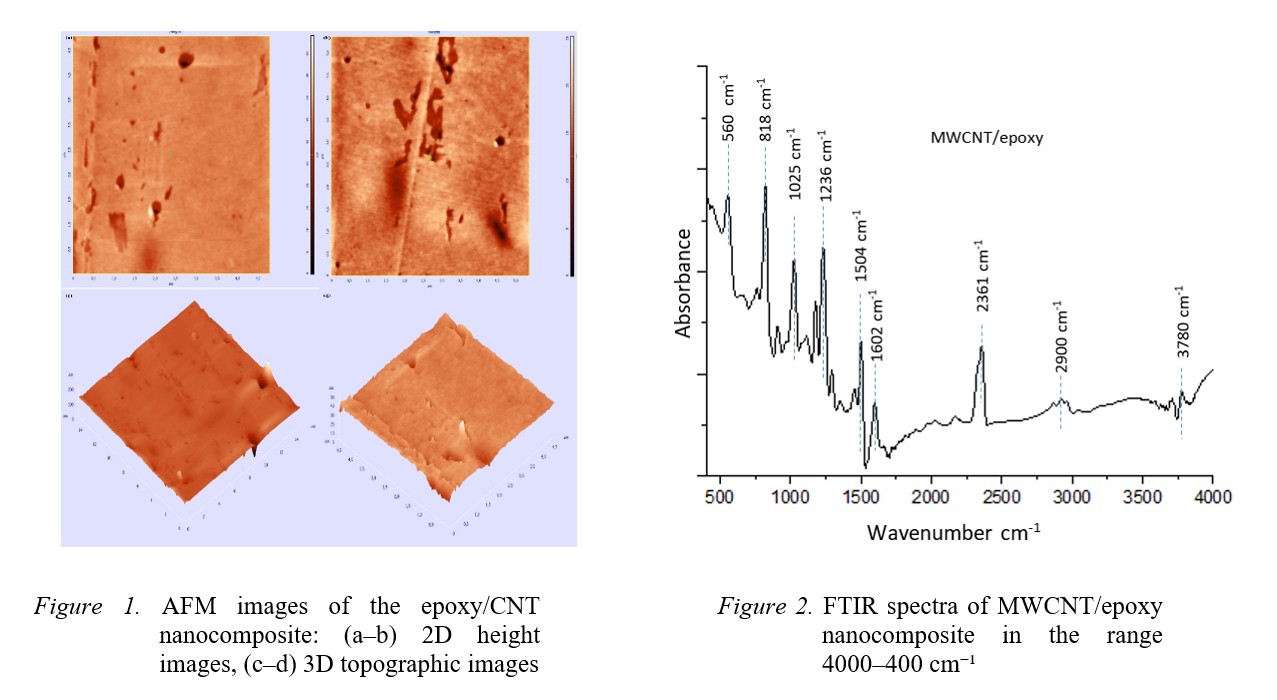
Fig.1-2
|
[1] A. Duongthipthewa, Y. Su, and L. Zhou. Electrical conductivity and mechanical property improvement by low-temperature carbon nanotube growth on carbon fiber fabric with nanofiller incorporation, Composites Part B: Engineering 182, 2020, 107581. https://doi.org/10.1016/j.compositesb.2019.107581
[2] M. Ponnusamy, L. Natrayan, S. Kaliappan, G. Velmurugan and S. Thanappan. Effectiveness of nanosilica on enhancing the mechanical and microstructure properties of kenaf/carbon fiber-reinforced epoxy-based nanocomposites, Adsorption Science & Technology, 2022, 4268314. https://doi.org/10.1155/2022/4268314
[3] J.J. Fekiač, M. Krbata, M. Kohutiar, R. Janík, L. Kakošová, A. Breznická, M. Eckert and P. Mikuš. Comprehensive review: Optimization of epoxy composites, mechanical properties, & technological trends, Polymers 17(3), 2025, 271. https://doi.org/10.3390/polym17030271
[4] J. Singh and A. Chauhan. Overview of wear performance of aluminium matrix composites reinforced with ceramic materials under the influence of controllable variables, Ceramics International 42(1), 2016, 56–81. https://doi.org/10.1016/j.ceramint.2015.09.098
[5] A. Bouhamed, C. Müller, S. Choura, and O. Kanoun. Processing and characterization of MWCNTs/epoxy nanocomposites thin films for strain sensing applications, Sensors and Actuators A: Physical 257, 2017, 65–72. https://doi.org/10.1016/j.sna.2017.01.022
[6] G. Friedbacher, T. Prohaska and M.Grasserbauer. Surface analysis with atomic force microscopy through measurement in air and under liquids, Mikrochimica Acta, 113, 1994 179–202. https://doi.org/10.1007/BF01242792
[7] M. Raimondo, C. Naddeo, L. Vertuccio, K. Lafdi, A. Sorrentino and L. Guadagno. Carbon-based aeronautical epoxy nanocomposites: Effectiveness of atomic force microscopy (AFM) in investigating the dispersion of different carbonaceous nanoparticles, Polymers 11(5), 2019, 832. https://doi.org/10.3390/polym11050832
[8] A. Dazzi, C.B. Prater, Q.C. Hu, D.B. Chase, J.F. Rabolt and C. Marcott. AFM–IR: Combining atomic force microscopy and infrared spectroscopy for nanoscale chemical characterization, Applied Spectroscopy 66(12), 2012, 1365–1384. https://doi.org/10.1366/12-06865
[9] T. Orujova, G. Gahramanova, R. Hasanov et al., Synthesis of multi-walled carbon nanotubes using various carbon sources via chemical vapor deposition – characterization of MWCNT-epoxy nanocomposites, Journal of Materials Science: Materials in Electronics 36, 2025, 1963. https://doi.org/10.1007/s10854-025-16054-6
[10] M.G. González, J.C. Cabanelas, and J. Baselga, Applications of FTIR on epoxy resins – identification, monitoring the curing process, phase separation and water uptake, Infrared Spectroscopy – Materials Science, Engineering and Technology 13 (2012) 262–284. https://doi.org/10.5772/36323
[11] M. Liu, H. Wu, Y. Wu, P. Xie, R. Pashameah, H. Abo-Dief, S. El-Bahy, Y. Wei, G. Li, W. Li, G. Liang, C. Liu, K. Sun and R. Fan. The weakly negative permittivity with low-frequency-dispersion behavior in percolative carbon nanotubes/epoxy nanocomposites at radio-frequency range, Advanced Composites and Hybrid Materials 5, 2022. https://doi.org/10.1007/s42114-022-00541-z
[12] P. Hiremath, Y.M. Shivaprakash, K. Keshyagol, S. Kowshik, B.M. Gurumurthy, D.V. Ghewade, S. Hiremath and N. Naik. Enhancement of mechanical and tribological properties of MWCNT-reinforced bio-based epoxy composites through optimization and molecular dynamics simulation, Journal of Composite Science 9, 2025. 176. https://doi.org/10.3390/jcs9040176
|